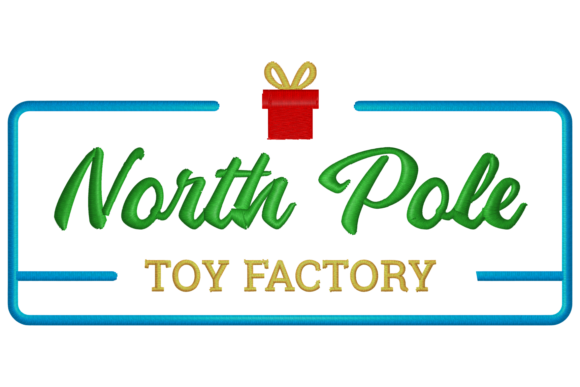
North Pole Factory: A Designer’s Real-World Embroidery Review
As a designer who’s digitized, stitched, and sold hundreds of embroidery files—and shipped thousands of finished handmade products—I opened North Pole Factory with quiet curiosity, not hype. Not because it’s flashy or trend-chasing, but because holiday-themed machine embroidery designs live or die by their quiet confidence: clean lines, thoughtful spacing, and the kind of charm that reads as handmade, not mass-produced. This one does.
First Impressions: Whimsy That Holds Up Under the Needle
North Pole Factory lands somewhere between nostalgic storybook illustration and crisp modern holiday branding. It’s not overly cutesy, nor is it minimalist to the point of sterility. There’s a subtle asymmetry in the chimney placement, a gentle curve to the roofline, and just enough detail—snow-dusted eaves, tiny window panes, a soft smoke curl—to suggest craftsmanship without demanding perfection from your machine. The “digitized by hand” note isn’t marketing fluff here; you can feel it in how the satin stitch wraps around the door frame and how the fill stitch builds texture in the snowbank without muddying the edges.
I tested it first on a medium-weight cotton twill tote bag—our go-to for boutique holiday gift sets. At 4.5 inches wide, the design sat comfortably centered on the front panel, with breathing room above the seam and clear visual weight against the natural fabric grain. Customers don’t see “stitch angle” specs—but they *do* notice when lettering doesn’t lean, when curves stay smooth across a curved surface, and when dense areas don’t pucker. North Pole Factory delivered on all three.
Where It Shines (and Where It Asks for Thought)
This isn’t a one-size-fits-all Christmas embroidery file. It thrives where intention meets execution:
- Sweatshirt embroidery: The moderate stitch density holds up beautifully on fleece-backed cotton. No sinking, no shadowing—just warm, dimensional texture that reads clearly even at arm’s length.
- Pillow covers and nursery decor: Its balanced proportions and friendly scale make it ideal for baby blankets, crib bumper accents, or linen pillow fronts. It feels personal—not promotional.
- Embroidered patches: With clean outer edges and minimal underlay bleed, it presses flat and bonds reliably to twill or denim. I backed it with tear-away + light cutaway stabilizer—no shifting, no distortion.
- Small shop product branding: Paired with a simple serif monogram or shop name on the reverse, it becomes part of a cohesive holiday line—not just decoration, but identity.
But let’s be practical: North Pole Factory isn’t magic. On ultra-thin rayon challis? Add extra stabilizer—or skip it entirely. On dark fabric, test thread colors first: a creamy ecru reads softer than stark white, and avoids that “halo” effect around fine details. And while it handles stretchy knits decently at mid-size (3.5–4.0”), avoid pushing it to the smallest available size on a t-shirt collar band—it simply wasn’t built for that kind of tight curvature.
What Your Customers Actually Notice
Here’s what matters beyond specs: how your finished product makes people *feel*. When I stitched North Pole Factory onto a cream-colored organic cotton apron for a local bakery’s holiday staff gift, customers paused. Not because it was loud—but because it felt considered. The slight variation in stitch direction (that “stitch angle” detail) catches light differently as the wearer moves, giving subtle life to the scene. It says “made for this moment,” not “downloaded and rushed.”
That translates directly to trust. Etsy sellers tell me buyers scroll past generic snowflakes but linger on designs with personality and restraint—like North Pole Factory. It doesn’t shout “CHRISTMAS!” It invites. And in a crowded handmade market, that quiet confidence often outsells flashier alternatives.
Designer Notes You’ll Want Before Threading Your Needle
Before committing to a batch of custom apparel or listing North Pole Factory as part of your digital embroidery file shop:
- Test on scrap fabric first—especially if using textured weaves (like herringbone or bouclé), where stitch definition can blur.
- Review stitch density visually, not just numerically. Dense fills near the chimney base look rich on stable fabrics but may need reduced density for lightweight tea towels.
- Confirm hoop size compatibility with your machine and project type. The 6 size options are helpful—but don’t assume the smallest will cleanly fit a child’s cap front without repositioning or trimming.
- Inspect small details at actual stitch-out size: the snowflakes on the roof, the door handle, the smoke swirl. They hold up well—but always verify under your own lighting and tension settings.
- Test black-and-white mockups before finalizing listings. Does the shape read clearly without color cues? Yes—with North Pole Factory, it does.
- Use proper stabilizer for your base fabric—not just “some.” Medium cutaway for knits, tear-away + light fusible for woven home goods, and always test wash one sample.
- Check licensing terms before selling finished products or reselling the digital embroidery file. This is a commercial-use-ready design, but confirm scope—especially for print-on-demand or large-batch production.
Final Thought: A Design That Serves the Project, Not the Other Way Around
North Pole Factory won’t solve every holiday embroidery challenge. It won’t replace an applique design when you need bold contrast or simplify a complex scene into flat shapes. But it excels where so many holiday files fail: it supports the handmade product instead of competing with it. Whether you’re stitching personalized gifts for neighbors, building a cohesive holiday collection for your craft business, or sourcing reliable design assets for client apparel work—it adds warmth without clutter, charm without cliché.
It’s the kind of embroidery file you keep in your “go-to folder”—not because it’s easiest, but because it consistently delivers on what matters most: clarity, character, and quiet professionalism. In a season full of noise, that’s worth more than perfect stitch count. It’s worth repeat customers, heartfelt thank-yous, and the quiet satisfaction of knowing your work looks exactly as intended—every single time.