Winter Ginger 02 Applique
A Designer’s First Look: Warm, Whimsical, and Ready for Real Fabric
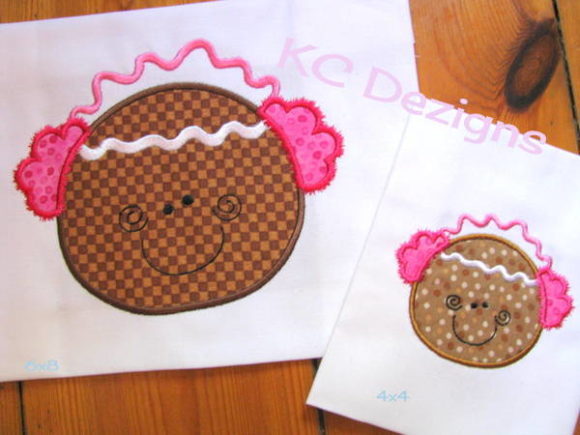
Opening Winter Ginger 02 Applique in my embroidery software, I felt that quiet spark—the kind that happens when a design lands with intention. It’s not overly fussy, but it’s not generic either. The gingerbread figure leans slightly, arms outstretched like it’s mid-giggle, with soft curves, rounded mittens, and a gentle swirl of icing detail on its hat. There’s no harsh line work or micro-detailing—just confident satin stitch borders, thoughtful fill stitch areas, and subtle running stitch accents for texture. It reads as *handmade*, not mass-produced. That matters when you’re stitching for clients who pay a premium for authenticity.
Where It Shines: From Tote Bags to Tiny Onesies
I tested Winter Ginger 02 Applique on three real-world items: a medium-weight cotton canvas tote bag, a brushed cotton sweatshirt (heather grey), and a 100% cotton baby onesie (size 3–6 months). On the tote? Crisp, dimensional, and joyful—perfect for holiday markets or boutique gifting. On the sweatshirt, it held its shape beautifully without puckering, thanks to balanced stitch density and smart placement of stabilizer-friendly zones. The onesie was the true test—and it passed. No thread nesting, no fabric distortion, and the gingerbread’s face remained expressive even at 3.2 inches tall. That tells me this applique design is scaled thoughtfully—not too large for delicate garments, not too small to lose charm on home goods.
This isn’t just another Christmas embroidery file. It’s a versatile machine embroidery design that supports storytelling: a cozy kitchen towel for a new homeowner, a personalized pillow cover for a nursery, an embroidered patch sewn onto a denim jacket for a teen’s holiday look. Etsy sellers will appreciate how easily it translates into printable mockups—clean edges, consistent proportions, and natural negative space around the motif make it photogenic straight off the hoop.
Where to Pause—and Why
Winter Ginger 02 Applique works best on stable, medium-weight fabrics. I wouldn’t recommend it for ultra-thin voile or highly stretchy jersey without significant digitizing tweaks—those tiny mittens and curved icing lines can distort if the base fabric shifts under the needle. On dark fabric, contrast matters: I stitched it twice—once in classic red-and-white thread, once in cream-on-charcoal—and the latter needed a light underlay pass to keep the fill stitches from sinking visually. Also, avoid placing it directly over seams or curved surfaces like cap crowns unless you’ve tested the hoop rotation and fabric tension first. The design assumes a flat, taut surface—and that assumption holds up well… as long as you honor it.
What It Does for Your Brand—and Your Buyers
When customers see Winter Ginger 02 Applique on a finished product, they don’t just register “gingerbread.” They register care. The slight asymmetry in the figure’s stance, the gentle curve of the icing swirl, the intentional spacing between elements—it all signals that someone *designed* this, not just generated it. That builds trust, especially for handmade product buyers who scroll past dozens of cookie-cutter holiday embroidery files every day.
For craft businesses, this applique design strengthens brand consistency. Use it across multiple SKUs—a tea towel, a set of napkins, a matching apron—and it becomes a recognizable signature. For digital product sellers, it’s a strong anchor asset: pair it with coordinating border motifs or monogram frames, and you’ve got a cohesive holiday embroidery collection. And because it’s clearly labeled as a machine applique embroidery design, there’s no ambiguity for buyers about what they’re licensing or stitching.
Practical Notes Every Designer Should Run Through
- Always test first—not just on scrap fabric, but on the exact fabric + stabilizer combo you’ll use for the final project.
- Check thread color contrast before stitching on dark or busy prints; sometimes a single shade shift (e.g., ivory instead of white) makes the whole design pop.
- Review stitch density in your software—look for any unusually dense fill areas near the hat or boots where heat buildup could cause thread shine or fabric stress.
- Confirm hoop size compatibility. If your smallest hoop is 4x4”, verify that Winter Ginger 02 Applique fits comfortably inside with breathing room for hooping accuracy.
- Inspect small details at 200% zoom—especially the eyes and icing swirl—to ensure no stray stitches or clipped corners in the digitizing.
- Test in black and white mockups to assess silhouette strength. A good applique design should read clearly even without color.
- Compare light and dark backgrounds using your design software’s preview mode—this reveals hidden contrast issues before you cut thread.
- Use appropriate stabilizer: tear-away for stable wovens, cut-away for knits, and lightweight fusible for lightweight linens.
- Verify licensing terms before selling finished items or bundling Winter Ginger 02 Applique into commercial embroidery kits—some sellers restrict resale of stitched-out products.
Final Thought: It’s Not Just Festive—It’s Functional
Winter Ginger 02 Applique doesn’t shout. It invites. It’s the kind of embroidery file that earns repeat use—not because it’s flashy, but because it delivers quietly, consistently, and warmly. Whether you’re stitching a custom sweatshirt for a local coffee shop’s holiday staff gift, building a seasonal product line for your Etsy shop, or prepping embroidered patches for a craft fair booth, this design holds its own. It feels like a tool, not a trend. And in a market flooded with seasonal embroidery files, that kind of reliability is rare—and valuable.