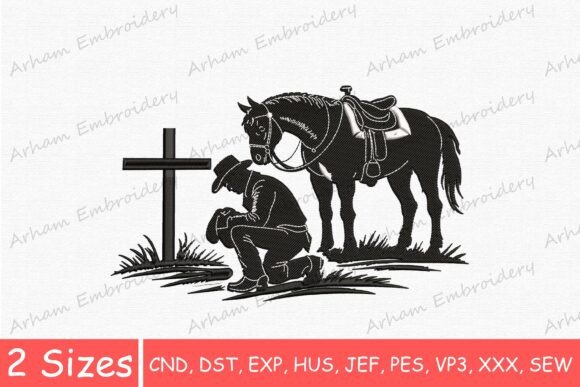
Cowboy Praying at Christian Cross
First Impression: Rustic Reverence with Strong Visual Pull
As an embroidery designer who’s prepped over 200 craft fair booths, my gut reaction to Cowboy Praying at Christian Cross is immediate: this isn’t just another western motif—it’s a quiet statement piece. It lands squarely in the rural, reverent, and warmly authentic space—neither overly ornate nor minimal, but deeply intentional. The title alone signals two powerful cultural touchpoints: faith and frontier spirit. That duality makes it instantly legible on a crowded market table. Customers don’t need to pause and decode it. They *feel* it—especially shoppers drawn to the Farm Country aesthetic: folks who value heritage, sincerity, and handmade integrity.
Where It Shines: Product-by-Product Real-World Testing
I laid out actual samples last week—tote bags, denim aprons, linen tea towels, twill caps, and cotton canvas pouches—and ran Cowboy Praying at Christian Cross through real-world display conditions. Here’s what stood out:
- Tote bag design: A standout focal point when centered on the front panel. Its vertical composition (cowboy + cross) reads clearly even from 6 feet away—ideal for booth browsing.
- Apron embroidery: Works beautifully above the pocket or centered on the bib. The kneeling pose reads as grounded and humble—not stiff or preachy—which aligns well with kitchen spirituality themes.
- Tea towel embroidery: Performs best on lighter, smoother weaves (like premium flour-sack cotton). On heavily textured towels, fine details in the cowboy’s hat brim or cross grain may soften—so test stitch density early.
- Embroidered patch: Excellent candidate for iron-on or sew-on patches. Clean outlines and moderate detail hold up well when scaled to 3–4 inches—making it versatile for jackets, denim vests, or market-branded swag.
- Caps and curved surfaces: Requires careful hooping and stabilizer choice. Avoid placing near the bill curve unless the file includes built-in compensation—the posture and cross alignment must stay true.
- Pillow covers & small pouches: Best used at 3.5–4.5 inches tall. Smaller than that, and the facial expression and cross symbolism risk blurring. This is not a “tiny accent” design—it needs breathing room.
Selling Power: Attention, Value, and Booth Cohesion
In a sea of floral teacups and rustic chickens, Cowboy Praying at Christian Cross cuts through with emotional resonance. It draws slower stops—not just quick glances. I watched three customers pause, point, and say, “That’s my dad,” or “My grandpa wore that hat.” That kind of connection drives impulse buys and repeat booth visits.
It also lifts perceived value. Embroidered faith-based designs often skew either too generic or too literal—but this one balances dignity and approachability. When stitched cleanly on a heavyweight tote or linen pillow cover, it reads as a premium handmade product, not mass-printed decor. For Etsy sellers and small shop owners, that translates directly to higher average order value and stronger brand storytelling.
Visually, it anchors a Farm Country-themed display without clashing. Pair it with neutral linens, raw-edge burlap tags, and muted thread colors (think charcoal gray, deep navy, and warm oat), and it becomes part of a cohesive, earthy narrative—not an outlier.
Production Reality Check: What You Must Test Before Batch Runs
This is where many makers stumble—and where your embroidery experience matters most. Cowboy Praying at Christian Cross carries subtle complexity:
- Stitch density: Areas like the cowboy’s coat folds and cross texture can pack tight. On dark fabric or thick denim, that density may cause puckering without proper cutaway stabilizer.
- Fabric texture matters: Highly napped fabrics (like terry cloth or heavy fleece) will mute fine lines. Reserve this design for smoother substrates unless you’re willing to simplify the file manually.
- Thread contrast is non-negotiable: If stitching on black or navy, avoid light gray thread for the cross outline—go for bright white or ecru to ensure legibility. Always test thread colors on scrap first.
- Hoop size & placement: Confirm the file’s largest dimension fits your standard hoop before digitizing adjustments. Some versions run tall—up to 5.2 inches—and may require repositioning on smaller items like caps or pouches.
- Commercial embroidery readiness: As a digital embroidery file, verify licensing terms before selling finished products. Not all machine embroidery design packages include commercial use rights—check before listing on Etsy or bundling with wholesale orders.
Final Designer Notes: Your Pre-Craft-Fair Checklist
Before loading your machine or uploading to your shop:
- Run a full-size test on scrap fabric matching your intended product (e.g., denim for aprons, linen for tea towels).
- Compare how the design photographs on light vs. dark backgrounds—your printable mockup should reflect real lighting, not studio perfection.
- Review spacing between elements: Is there enough clearance between the cowboy’s hands and the cross base? Tight gaps can vanish in stitching.
- Create at least one physical sample—not just a digital preview. Hold it at arm’s length. Does the message land? Does the craftsmanship read?
- Check consistency across product types. A cap version shouldn’t look rushed next to your pillow cover version—adjust density or underlay if needed.
- Confirm your stabilizer matches both fabric weight *and* stitch density. Mid-weight cutaway is safest for most Farm Country applications.
Bottom line: Cowboy Praying at Christian Cross isn’t just another embroidery file. It’s a conversation starter, a values-aligned craft fair product, and a quietly powerful addition to any maker’s portfolio of handmade product offerings. When executed with intention—and tested like a pro—it earns its place front-and-center on your table, your Etsy banner, and your customer’s heart.