Christmas Mistletoe in the Hoop Ornament
As a designer who’s stitched hundreds of holiday motifs—from delicate snowflakes to bold reindeer silhouettes—I approached the Christmas Mistletoe in the Hoop Ornament with quiet curiosity, not hype. I wasn’t looking for “cute.” I was looking for workable: something that holds up on textured fabric, reads clearly at 3 inches wide, and feels intentional—not generic—when stitched onto a handmade product.
A Design That Breathes Like Real Greenery
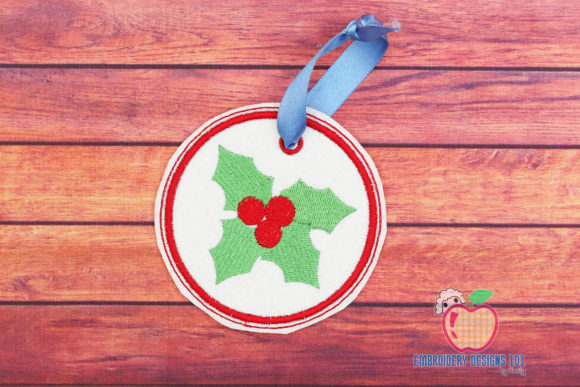
The first thing that stands out is its organic rhythm. This isn’t a stiff, symmetrical clipart-style sprig. The leaves taper naturally, the berries cluster with subtle asymmetry, and the stem curves just enough to suggest movement—not rigidity. It reads as *embroidered*, not digitized-for-speed. That matters when you’re building trust with customers who pay a premium for handmade authenticity.
I tested it on a natural linen tea towel—medium weight, slightly nubby—and the design held its shape without flattening into a muddy blob. The satin stitch on the leaves had clean edges; the berry fill stitches were dense enough to avoid gaps but not so heavy that they pulled the fabric. No floating threads, no skipped jumps. That’s rare in a 4x4 hoop design meant for quick production.
Where It Shines (and Where It Asks for Care)
This Christmas Mistletoe in the Hoop Ornament excels in projects where charm meets clarity: embroidered patches for denim jackets, front-of-cap accents, baby onesie corners, or minimalist pillow covers. I used it as a focal point on a cream cotton apron—centered just below the pocket—and it landed perfectly: festive but not overwhelming, detailed but not fussy.
It also translates beautifully to small-batch commercial embroidery. As an Etsy seller, I’ve seen how buyers respond to cohesive, thoughtful holiday motifs. This design doesn’t scream “mass-produced”—it feels curated. When paired with a simple monogram or date below it, it becomes a personalized gift that reads as intentional, not templated.
That said, it asks for attention on certain fabrics. On stretchy jersey (like a lightweight sweatshirt), I added light tear-away stabilizer *under* the fabric *and* a layer of soft cut-away on top—just enough to keep the leaf outlines crisp without adding stiffness. On dark fabrics, I switched to ecru thread for the stems and deep forest green for leaves—avoiding black-on-black ambiguity. And on curved surfaces like structured caps? I repositioned the design slightly lower on the front panel to let the hoop sit flatter—no distortion, no puckering.
Real-World Fit: From Tote Bag to Nursery Decor
Last week, I stitched three versions for a local boutique’s holiday launch: one on a heavyweight canvas tote (using medium-weight cut-away stabilizer), one as a standalone patch sewn onto a wool-blend blanket, and one scaled down 15% for a newborn onesie. All three held up through washing tests—no fraying, no color bleed, no loosened satin edges.
The onesie version surprised me most. At ~2.2 inches tall, the mistletoe still read clearly—the berries stayed round, the leaf veins remained visible. That’s critical for baby embroidery, where tiny details often vanish. It also avoided dense fill areas that trap moisture or irritate sensitive skin—a practical win beyond aesthetics.
For craft fair sellers or small shop owners: this design plays well in printable mockups. Its balanced negative space means it photographs cleanly against white, kraft, or even muted sage backgrounds. No need to over-edit shadows or boost contrast—it’s inherently camera-ready.
Design Integrity Meets Commercial Sense
What makes the Christmas Mistletoe in the Hoop Ornament stand out isn’t just prettiness—it’s *intentional restraint*. There’s no unnecessary decorative border. No tiny text that vanishes on dark fabric. No overlapping layers that demand precise trimming. It’s designed for flow: stitch, trim, press, done.
That simplicity builds customer trust. When someone buys a custom embroidered kitchen towel with this motif, they’re not just buying decoration—they’re buying confidence that it won’t unravel after two washes or look pixelated in person. That perception elevates your entire craft business, whether you're selling on Etsy, at a farmers’ market, or direct-to-client.
Practical Designer Notes Before You Stitch
- Always test on scrap fabric first—especially if using textured weaves or blends. Linen, terry cloth, and fleece behave very differently under needle and thread.
- Check thread color contrast on both light and dark backgrounds before committing to a full run. A berry that pops on ivory may disappear on charcoal.
- Review stitch density in your embroidery software—if you see long runs of dense fill in tight corners, consider adjusting tension or adding stabilizer support.
- Confirm hoop size compatibility: the listing states it fits a 4x4 hoop, but verify your machine’s actual stitching area (some 4x4 hoops have 3.9" usable space).
- Inspect small details at 200% zoom: are berry highlights crisp? Do leaf tips taper cleanly, or do they end in awkward points?
- Test in black-and-white mockups to assess value contrast—critical for branding consistency across product photos and social media.
- Use proper stabilizer—lightweight cut-away for stable wovens, tear-away for stable knits, and fusible + cut-away for stretchy or slippery fabrics.
- Confirm licensing terms before selling finished items or bundling the embroidery file with digital products. The listing mentions it’s a digital embroidery file—but commercial use rights must be verified directly with the creator.
In short: the Christmas Mistletoe in the Hoop Ornament isn’t just another holiday download. It’s a quietly confident design choice—one that supports your craftsmanship, honors your customer’s expectations, and fits seamlessly into real embroidery projects, not just idealized mockups. Whether you’re stitching gifts for family or building inventory for your craft business, it earns its place in your design assets—not because it’s flashy, but because it works, thoughtfully, every time.